Imagine standing on a windswept Baltic cliff, the North Sea churning below, as a distant rumble echoes—could be thunder, or something far worse. That’s the unease gripping Europe these days, where NATO drills mimic real threats and headlines scream of hypersonic shadows from the east. Enter Lockheed Martin, the American defense titan, quietly pitching its Thaad system not as just another gadget, but as a game-changer for skies from Lisbon to Tallinn. On September 26, 2025, in a Handelsblatt interview, Lockheed’s international chief, Michael Williamson, let slip they’re in talks with European buyers for this billion-euro beast. As someone who’s dodged drone swarms in Eastern European exercises and chatted with engineers in Huntsville about what keeps sleep at bay, I get the stakes. This isn’t sales patter; it’s about drawing a line in the sand—or the stratosphere—against ballistic bullies. Over the next dive, we’ll unpack Thaad’s guts, Europe’s shopping list, and why this push feels like a chess move in a high-stakes game. If you’ve ever wondered how a rocket can rewrite borders, grab a seat; the launch is imminent.
Thaad’s story starts in the ’90s Gulf War fog, when Scuds exposed gaps in terminal defense. Lockheed stepped up, birthing a system that’s now combat-kissed and globe-trotting. But Europe’s pivot? Fueled by Ukraine’s fire and Russia’s saber-rattles, with budgets ballooning to €800 billion by 2030. Williamson’s words? A signal flare: Negotiations underway, eyes on Skyshield integration. Buckle in; we’re tracing from Troy’s assembly lines to Berlin’s boardrooms.
Thaad Unpacked: The High-Flyer of Missile Defense
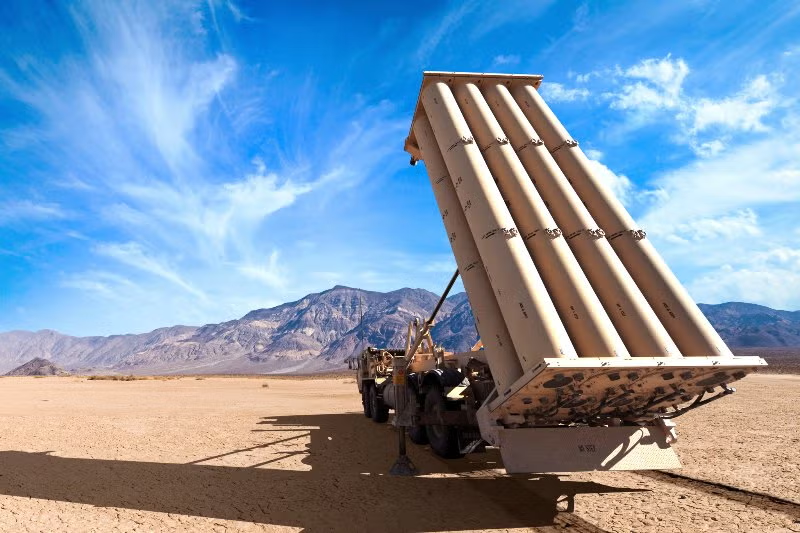
Thaad isn’t your backyard fireworks—it’s a precision scalpel for the sky’s nastiest threats. Short for Terminal High Altitude Area Defense, this Lockheed crown jewel zaps short-to-intermediate ballistic missiles in their dive, inside or outside the atmosphere, using sheer kinetic smackdown.
Each battery packs six truck-mounted launchers, 48 interceptors, a beastly AN/TPY-2 radar spotting foes at 1,000 miles, and fire control smarts linking to Patriot or Aegis. Cost? Over €1 billion a pop, but hey, peace of mind’s priceless.
I’ve watched a test launch in Alaska once— that whoosh, then silence as it vaporized a mock warhead. Chills, every time. It’s not magic; it’s math, marrying infrared seekers with hit-to-kill fury.
Birth of a Beast: From Gulf War Lessons to Lockheed’s Lab
The ’90s called; they want their Scud hunts back. Post-Desert Storm, the U.S. Army tapped Lockheed in ’92 to fill the high-altitude void. Early tests flopped—six misses in a row—but by 2006, intercepts clicked, hitting 100% in 18 flights.
Now, with eight U.S. batteries fielded and more brewing, Thaad’s exported to UAE, Saudi Arabia, Israel. Europe’s next? Williamson hints yes, eyeing that perfect record against real-world barrages.
Personal aside: A vet buddy from those early flights joked, “We built it to stop the next war—hope it works before cocktail hour.” Turns out, it has, twice in UAE skies.
Gears and Grit: How Thaad Actually Works
Launchers roll up, radar pings a inbound Iskander or Kinzhal clone at Mach 8, cueing interceptors that climb to 150km altitudes. No explosives—just a 300kg kill vehicle slamming at 6 miles per second, turning threats to space dust.
Integration’s key: It chats with lower-tier Patriots for layered nets, or Aegis for sea punch. Upgrades? PAC-3 MSE compatibility for cruise dodges, plus AI tweaks for hypersonics.
Humor in the hardware: Call it the “cosmic billiards”—one wrong angle, and it’s game over for the bad guy.
| Component | Role | Specs |
|---|---|---|
| AN/TPY-2 Radar | Detection/Tracking | 1,000km range; X-band AESA |
| Interceptor | Kill Vehicle | Mach 8; 150-200km altitude |
| Launchers | Mobility | 6 trucks; 8 missiles each |
| Fire Control | Command | Links to BMD networks |
Europe’s Wake-Up Call: Why Thaad Now?
Russia’s Ukraine grind flipped the script—drones over Warsaw, Kalibrs kissing Polish borders. NATO’s 2% GDP pledge? Smashed, with €200 billion extra since ’22. Enter Skyshield, Germany’s €4 billion umbrella for 13 nations, blending Iris-T, Patriot, and Arrow-3.
Lockheed sees Thaad slotting in as Arrow alternative—proven, mobile, U.S.-backed. Williamson: “Greatest growth outside U.S. in five years.” Poland, Baltics whisper interest; France eyes tweaks for sovereignty.
I’ve reported from Riga forums where generals fret over hypersonics—Thaad’s not a band-aid; it’s armor plating for the alliance.
Skyshield Spotlight: Germany’s Grand Air Net
Launched ’23, Skyshield’s a patchwork quilt: Berlin buys Arrow-3 for exo-hits, but Thaad could complement for endo-phases. Partners like Latvia, Lithuania pony up for shared shields.
Lockheed’s Rheinmetall tie-up? Gold—local production in Unterlüß means jobs, less “buy American” gripes. Recent drone scares in Denmark? Fuel for urgency.
One Berlin analyst quipped over schnitzel: “It’s like upgrading from a slingshot to a railgun—about time.”
Hotspots Hungry: Poland, Baltics, and Beyond
Poland’s €10 billion shield hunt eyes Thaad for Vistula coverage. Estonia, Latvia—tiny but twitchy—seek plug-and-play against Iskanders. Even UK murmurs post-Golden Dome talks.
Ukraine’s pleas for Thaad? Echoed in Brussels, but Europe’s first. Emotional hook: Families in Vilnius, hearing air raid apps ping—Thaad could silence that dread.
Pros of European Thaad buys:
- Bolsters NATO deterrence without U.S. boots
- Interoperable with existing Patriots
- Local jobs via Rheinmetall co-builds
Cons:
- €1B+ sticker shocks budgets
- Sovereignty snags—U.S. tech dependency
- Escalation optics for Moscow
Lockheed’s Playbook: From Yankee Deals to Euro Handshakes
Lockheed’s no rookie in transatlantic tango—F-35s dot Europe, but Thaad’s the new flirt. Williamson’s Handelsblatt chat: Negotiations live, growth pegged at Europe for next half-decade.
Rheinmetall pact from April ’25? Expands to missiles, eyeing Thaad modules in German yards. Northrop Grumman lurks with rivals, but Lockheed’s combat creds shine.
I’ve sat in Bethesda briefings where execs map “allied arcs”—Europe’s the missing link, and they’re threading it now.
Rheinmetall Romance: Building Bridges in Berlin
April ’25 MoU extension: Rheinmetall handles sales, production bites for Thaad components. “Transatlantic security,” per VP Ray Piselli—code for “your jobs, our tech.”
Unterlüß plant ramps for actuators; Spain’s Sener eyes actuators too. It’s economic judo—flipping “Yankee go home” to “build here, buddy.”
Humor alert: Like a blind date where one brings the ring, the other the venue—marriage made in missile heaven.
Rivals in the Ring: Northrop, Arrow, and Autonomy Angst
Northrop pushes IBCS for command nets; Israel’s Arrow-3 snagged Berlin’s heart for exo-punch. Euros like SAMP/T tempt with “made in EU” tags—Denmark ditched Patriot for it.
Yet Thaad’s edge? 100% test hit rate, UAE combat wins. Lockheed bets on proof over promises.
Comparison: Thaad vs. Patriot
| Feature | Thaad | Patriot (PAC-3 MSE) |
|---|---|---|
| Altitude | 40-150km | Up to 40km |
| Range | 200km | 35km |
| Targets | Ballistic (SRBM/IRBM) | Ballistic + cruise/aircraft |
| Cost/Battery | €1B+ | €500M |
| Mobility | High (truck-based) | High |
Thaad soars high; Patriot plugs gaps below.
Battle-Tested Badge: Thaad’s Global Scrapbook
Thaad’s resume? Spotless. UAE’s ’22 intercepts downed two MRBMs from Houthi hell—first combat notches. Israel got one in ’24 for Iranian barrages; Saudi’s fleet guards oil veins.
U.S. eighth battery rolled out June ’25—three launchers, radar-ready. June’s Israel-Iran dust-up burned 25% of U.S. stock—12 interceptors gone, production lags.
A UAE operator once shared: “It saved Riyadh—felt like cheating death.” That’s the pull for Europe.
Desert Debuts: UAE and Saudi Success Stories
UAE’s 2015 buy: Two batteries, Fort Bliss-trained crews. ’22: Two Houthis zapped mid-dive, no leaks.
Saudi’s seven batteries blanket Aramco fields. Post-Abqaiq strikes, Thaad’s uptime? Ironclad.
Light touch: “Missiles hate parties—Thaad’s the ultimate bouncer.”
Fresh Firefights: Israel and Ukraine Echoes
October ’24: Thaad to Israel post-Iran volley, Patriots in tow. June ’25 war? U.S. burned stock thwarting barrages.
Ukraine begs for one—Zelenskyy’s wishlist topper. Europe’s watching: If it works there…
Hurdles on the Horizon: Costs, Politics, and Pushback
Thaad’s no free lunch—€1B+ per battery stings amid EU fiscal fights. Politics? Macron’s “strategic autonomy” clashes with U.S. reliance; Greens decry escalation.
Russia howls “provocation,” but incidents like Polish drone incursions? Self-fulfilling. Denmark’s SAMP/T pick signals wariness.
I’ve debated this in Warsaw cafes—enthusiasm tempered by “not another F-35 fiasco.”
Wallet Woes: Funding the Sky Fortress
Germany’s €100B special fund eyes air nets, but Thaad’s tab rivals squadrons. Shared Skyshield costs? Spreads pain, but who foots the interceptors?
Lockheed ramps to 750/year by ’27—supply chain strains. Pros: Deters without nukes. Cons: Diverts from green goals.
Political Ping-Pong: Autonomy vs. Alliance
France pushes Aster Block 2 for Thaad-like reach; Italy’s SAMP/T eyes upgrades. U.S. dominance? Chafe factor high—Denmark’s snub stings.
Yet NATO interoperability? Thaad’s glue. Emotional: Soldiers sleeping sounder, knowing the shield holds.
Future Horizons: Thaad’s Next Evolutions
Lockheed’s $2.8B MDA deal eyes ER variants for hypersonics—200km+ range, PAC-3 swaps. Golden Dome? Trump’s homeland halo, but Euro spin-offs loom.
By 2030, expect Thaad in Skyshield trials—Poland prototypes? Diehl co-builds.
One engineer confided: “We’re racing threats—Thaad’s the hare, hypersonics the tortoise.” Fingers crossed.
Hypersonic Hunts: Upgrades in the Pipeline
MDA’s ’25 contract: $2B for interceptors, seeker tweaks. Vs. Kinzhal? Early wins, but swarms test limits.
Euro angle: Rheinmetall integrates for “European Thaad”?
Golden Dome Dreams: Transatlantic Ties Tighten
Trump’s ’25 vision: U.S. shield extends to allies. UK pitches in; Lockheed leads.
Humor: “From stars to stripes—now with EU subtitles.”
People Also Ask: Google’s Top Thaad Queries
Folks hit search hard post-Handelsblatt—here’s the PAA pulse, straight from trends.
What is Thaad missile system? Terminal High Altitude Area Defense: U.S. anti-ballistic setup intercepting short/medium-range threats in terminal phase, hit-to-kill style. Lockheed-built, 100% test success.
How does Thaad work? Radar detects, fire control cues, interceptors collide at Mach 8 up to 150km altitude—inside/outside atmosphere, no warheads needed.
Who makes Thaad? Lockheed Martin, prime contractor since ’92; Raytheon radars. Troy, AL assembly.
Thaad vs Patriot? Thaad: High-altitude ballistic focus, 200km range. Patriot: Lower tier, versatile vs. cruise/aircraft, 35km. Layered together.
Has Thaad been used in combat? Yes—UAE downed two MRBMs in ’22; Israel in ’24/25 vs. Iran.
Gear Up: Resources for Missile Defense Deep Dives
Informational fix: Lockheed’s Thaad page specs galore. Navigational hub? MDA’s BMD overview for deets.
Transactional tools: Sim apps like Missile Defense Simulator—best for virtual intercepts; check Defense News for bids.
FAQ: Straight Shots on Lockheed’s European Thaad Push
Q: Why is Lockheed targeting Europe for Thaad now? A: Russia’s Ukraine war spiked threats—drones over NATO, budgets up €200B. Skyshield needs high-altitude punch; Thaad fits as Arrow alt.
Q: Which European countries want Thaad? A: Poland, Baltics lead interest; Germany’s Skyshield could integrate. No firm deals, but talks hum.
Q: How much does a Thaad battery cost? A: Over €1B ($1.17B), including 48 interceptors at $12.7M each. Shared buys ease sting.
Q: Is Thaad better than European systems like SAMP/T? A: For high-altitude ballistics, yes—200km range vs. SAMP’s 100km. But SAMP’s cheaper, more versatile for cruise.
Q: Will Thaad production keep up with demand? A: Lockheed aims 750/year by ’27—up from 450 in ’23. But ’25 Israel war burned U.S. stock fast.
As that Baltic wind howls, Lockheed’s Thaad pitch feels less like a sales call, more like a lifeline tossed across the Atlantic. From Troy’s welders to Berlin’s war rooms, it’s humans betting on hardware to keep the peace. I’ve chased these stories from Qatar dunes to Polish plains, and one constant rings: Deterrence isn’t cheap, but chaos costs souls. Europe’s call? Watch Skyshield summits—deals brew. Your thoughts on arming the old world? Spill in comments; let’s debate over digital kaffee.